
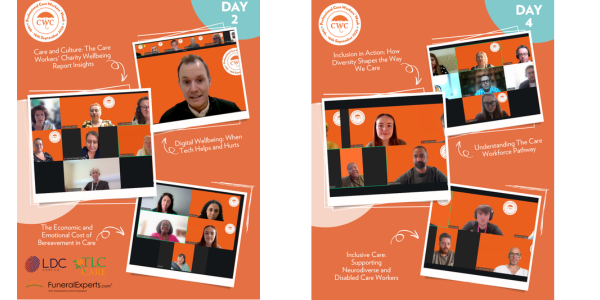
Writing for The Care Workers' Charity, Policy and Projects Manager Olivia Firth highlights key moments from Professional Care Workers Week 2026, including direct government engagement on the Fair Pay Agreement and key discussions on carer wellbeing.
Professional Care Workers' Week is now a fixture in the sector calendar, and this year's programme brought care workers together with providers, policy makers, regulators and sector organisations across fourteen free sessions.
Twelve months ago, we were still arguing that care workers belonged in policy discussions at all. This year, a senior policy lead from the Department of Health and Social Care presented on the Fair Pay Agreement, then sat and listened while a care worker set out what would make it a genuine turning point rather than words on paper; that is not a small shift.
The week opened with careers within the sector, and with the question of why care work is still treated as a stopgap rather than a profession. The answer that emerged was structural rather than a matter of ambition. Care workers cannot see where the next step is, and when they find it, the pay differential is often measured in pence. One panellist described colleagues weighing up promotion and concluding they were better off picking up extra shifts. Until time served and responsibility are properly reflected in pay, the career conversation will keep stalling.
Fair pay dominated the week, as it should. The Fair Pay Agreement will change how pay is negotiated for the first time in this sector's history, though the first agreement is not expected to take effect until 2028. Care workers on our panels were clear about what they need from it: money that reaches them in full, with no groups left behind, conditions that are not cut elsewhere to fund it, and pay that reflects the responsibility they carry. Wage compression came up repeatedly and deserves serious attention from everyone involved in the negotiations.
Our session on delegated healthcare activities produced some of the starkest evidence of the week. Our survey of over 300 care workers found that 67% have been asked to carry out a delegated healthcare activity, 93% have never received additional pay for it, and 29% feel rarely or never able to refuse a task outside their training. Care workers are absorbing clinical responsibility without the training, supervision or remuneration that should accompany it. The sector needs a clear national definition of what counts as a delegated activity, and it needs one soon.
There were harder conversations too; on bereavement, on violence at work and on what the proposed settlement changes mean for internationally recruited care workers, who are carrying considerable uncertainty while continuing to turn up and deliver excellent care.
The week was not only about what is wrong. Our 2025 Wellbeing Survey found that 77.76% of care workers are satisfied with the training they receive, which tells us something is working. Providers shared practice that costs little and changes a great deal: consistent rota patterns for a neurodivergent colleague, written instructions rather than verbal ones, supervision reframed around personal growth rather than
compliance. The adjustments that get called exceptional are usually small, and usually better for everyone.
One member of our Care Worker Advisory Board and Champions Project told us on a panel: "Before joining the project, I didn't know my rights as a care worker. Now I know them, and I'm passing that knowledge on to my colleagues." Another put it this way: "If I was 30% confident before, now I am 90% confident. We know our rights, we know how to raise concerns, and we know our voices are being listened to."
Professional Care Workers’ Week is not only a celebration of care workers, though they deserve one, but a demonstration that when you give skilled professionals a platform, they use it well. The sector's job now is to make sure that platform is not something we build only once a year.
For the full recordings of Professional Care Workers’ Week 2026, please follow this link: The Care Workers' Charity - YouTube