
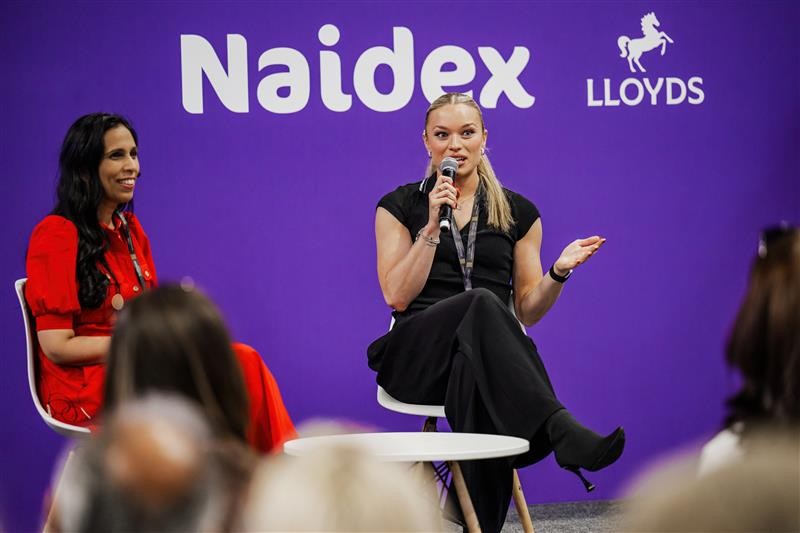
When Gladiator Jodie Ounsley, aka Fury, spoke on the Main Stage at Naidex 2026, she captivated the audience with her personal story of defying the odds to become a sporting icon.
Speaking to Jessica Schibli, Head of Creative Diversity at the BBC, she reflected on the challenges she faced growing up profoundly deaf, the mindset and clever tactics that helped her overcome setbacks, and the courage it has taken to open up conversations about accessibility for deaf people, both on the rugby field and in the Gladiators arena.
For those who were unable to join the session, or for attendees who would simply like a reminder of the inspiring conversation, here it is in full, along with a Q&A with audience members, where she reveals her two favourite Gladiators!
You’re most well-known for your appearance on Gladiators, but could you tell me about your early sporting career and how being deaf impacted your journey?
I was born in Yorkshire, in a small town called Dewsbury. And I was born profoundly deaf, so that basically means I don’t have any hearing in both ears.
At that time, my mum and dad didn’t know anyone else who was deaf, so they didn’t know what to do with that information and what resources were available. This experience was made worse because they were told by the doctor that I won’t ever speak, I won’t get a job and I won’t be successful, which is quite mind-blowing thinking about it now.
For most people, when a professional gives you information like that, you just naturally believe it. But for my mum and dad, being the hardworking people they are – my dad was in the police for 30 years - their mindset was “what can we do and how can we support Jodie in the best way possible?”.
They were later advised that I should have a cochlear implant fitted. This is basically a magnet in my head that sends electrical signals straight to my brain, and my brain then interprets this as sound. I got that fitted when I was 14 months old and, from there, I went to mainstream school, and I had lots of rehab and speech therapy.
Very early on, even though I didn’t understand what being deaf meant and the challenges that came with it, I loved sports. The first event I came across was the World Coal Carrying Championships – it’s a Yorkshire thing!
You basically have a sack of coal and your shoulders, and you start from the pub, and the first one who gets to the maypole wins. I used to watch my dad take part, and as a toddler, I’d run around the kitchen with a sack of carrots on my shoulders. From that moment, my dad knew I was going to enjoy sports. So, I signed up for my first race at the age of three – you’re supposed to be five, but we lied about my age! I absolutely loved it, and it was the one thing that really made me feel safe. It didn’t really matter that I was deaf; I could get involved regardless, so that’s where it all started.
You’re such a brilliant role model for so many people. Is the confidence you project something that’s always come naturally to you?
I’ve always had fire in my belly to be successful, but in terms of confidence, no, not at all. When I was young, I was really shy. I’m still a shy person now - I’m just a lot better at putting a brave face on. That’s something I’ve had to work on over the years, especially with me being deaf. There were so many times where I didn’t have the confidence to speak up if I was struggling.
I’ve always used humour as a way to talk about being deaf, and I’ve found this helps people feel more at ease, which then opens the conversation about how they can support me. A lot of the time, it’s about faking it until you make it and throwing yourself in at the deep end.
You played rugby professionally for a number of years. How did you get into this sport?
I always loved physical sports - I went on to win the Coal Carrying Championships five times! After that I moved into athletics and by the time I reached my teens I started doing Brazilian jiu-jitsu. My dad was also involved in this, and so our Saturday nights were usually spent fighting in the garage before Britain’s Got Talent came on the TV.
Then, when I was about 15, I started going to watch my younger brother play rugby. I’d be stood there thinking “this is a bit of me – I really want to try this”. So, I approached my mum and dad about joining a team, but the medical advice that we were given at the time was not to take part in contact sports due to the risk of the magnet inside my head becoming dislodged and causing complications.
Saying no to me was hard for my parents because they wanted to support me in everything I wanted to do. But in the end, I think my dad got sick of me asking about it, so he started looking into things we could do to help me take part in rugby safely.
My dad was amazing – he spoke to all different specialists – and we came to the conclusion that if I want to play rugby, the risk was ultimately my responsibility. I’d also have to wear headguard, I remember my dad saying to me, “if you don’t wear it, you’re not stepping onto that field”. So, I said “deal,” and I never once forgot to take it with me.
I went to my first training session, and I didn’t have a clue about the rules, but I absolutely loved it. What I didn’t realise then was that my life was about to change forever. By 16, I had moved away from home to join the rugby pathway at Loughborough College, and when I turned 18 and preparing to start university, I got a call from the England women’s team asking me to join.
What was your experience playing professional rugby as a deaf person?
There was a lot for me to adjust to. I went from living in Loughborough to living in Twickenham and travelling the world. I was only 18, and, as I’ve said, I was really shy, so I was incredibly nervous when I turned up to my first training session. I was also worried about how I would fit into the team as a deaf person. At the time, I didn’t want to ask for support because I just felt so lucky to have been given this amazing opportunity. Looking back now, it seems silly, but that’s genuinely how I felt in that moment.
Everyone was so supportive, but it felt like there was an elephant in the room because they knew I was deaf – they could see my cochlear implant – but no one wanted to talk about it. Later, we were asked to do a presentation about ourselves and our rugby journey as a way to bond with our team, and I realised it was a perfect time to explain that I’m deaf and share the things I struggle with. As soon as I’d done it, lots of people started asking questions and it opened up a huge conversation. From that point, everyone went above and beyond for me.
Moving on to your TV career, what it was it like when you first got the call to become a Gladiator?
That was crazy. Gladiators had always been part of my family – my dad was a contender in a previous series, and I remember going to watch him take part when I was about seven.
Fast-forward to 2023, I was at an England training camp, and an article came up on social media saying Gladiators was making a comeback. I said to my family, “we’ll have to get together and watch it on TV”, and my dad, being my typical dad, suggested that I should apply. I didn’t think I’d be the right fit, but I applied, forgot about it, carried on playing rugby, and after a few months, I was invited to a trial. I thought it was a spam email!
Anyway, I went to the trial, and it was absolutely savage! The room was full of athletes from all different backgrounds, and there were about ten different stations testing everything from speed to agility. I just thought to myself, “I’ll enjoy the experience, go home, and probably won’t get any further”. But after a few weeks, I got a call from the BBC asking me to become a Gladiator named Fury.
That was incredible, because doing something like this wasn’t just for me - it was for my family and, also, for younger generations. Even before Gladiators, I’ve always been passionate about encouraging young people to get into sport regardless of their ability. So, in my head, I knew I had to do it.
True inclusion often starts with simply asking people what their access requirements are. How did the Gladiators team support you in that process?
From the very first call, the producers were brilliant. They didn’t pretend to know what I needed - they were just really honest and said, “we haven’t worked with anyone who is deaf before, so what do you need, what might you struggle with, and how can we help?”
A lot of features on the show have been adapted for me, though you’d never notice by watching it. Even small adjustments, like the referees using arm signals for stop and start because, with all the noise in the arena, I can’t hear the whistle. There have been so many moments where we’ve had to tweak things; it’s been a constant learning curve for everyone involved.
During one episode, I was taking part in The Edge, which is suspended really high in the arena. The referee shouted, “Gladiators ready,” and I was supposed to do my signature move, but I didn’t hear it. The camera was on me, and I was just looking around! I told the producers I couldn’t hear the ref, and two minutes later they came out with a big white sheet of paper saying, “Fury, pose now!” It worked brilliantly.
Your book, Strong Girls, is out now. Where does your inner strength come from?
Doing the sports I enjoy and the opportunities I’ve had to represent my country has all come down to being strong, not just physically, but mentally as well. I always say that I get my physical side from my dad and my good heart from my mum. Strong Girls is a kids’ book and I’m so excited about it because representation and being a strong role model for young people is so important.
AUDIENCE Q&A
How do you manage the mental pressure of competition? Is there anything you do to prepare yourself?
When I was younger, I was taking part in an athletics competition. I remember being so nervous and then, incredibly, Linford Christie came up to me and said, “nerves is a good thing”. And that’s stuck in my head ever since. So now I just think that if I’m nervous, I really care about what I’m about to do, so I’ve used the nerves to my advantage, in a way.
I was born hearing and went completely deaf six years ago. I have faced so many stereotypes about what it means to be deaf. What is one stereotype that you would like to put an end to?
A lot of the time, people doubt what you’re capable of when you're deaf and put you into a box. So, I want people to see disability as not a negative thing but just a different way of living and adapting.
I’m a rugby player, and a lot of my teammates have some level of hearing impairment and can’t always hear the whistle when they’re on the pitch. Did you ever experience this, and how did you overcome this?
There’s been so many times where the whistle has blown and I, not hearing it, have ran the full length of the pitch thinking I’ve scored an absolute sick try! My teammates were great, though – we’d come up with different signs for tactics and moves. Also, I’m able to lip-read, so when the opposition were talking amongst themselves, I was able to say “right, this is what they’re going to do!”
Who’s your favourite Gladiator?
My favourite male gladiator is Hammer. He’s a cool guy, and he used to do fighting, so we’ve bonded on that. My favourite female Gladiator has got to be Cyclone. She is so strong. In my whole rugby career, I’ve never met anyone as strong as her. She’s no joke!
What are you most proud of?
I think the thing that has made me most proud has been being able to give back to my mum and dad and just making them happy.