
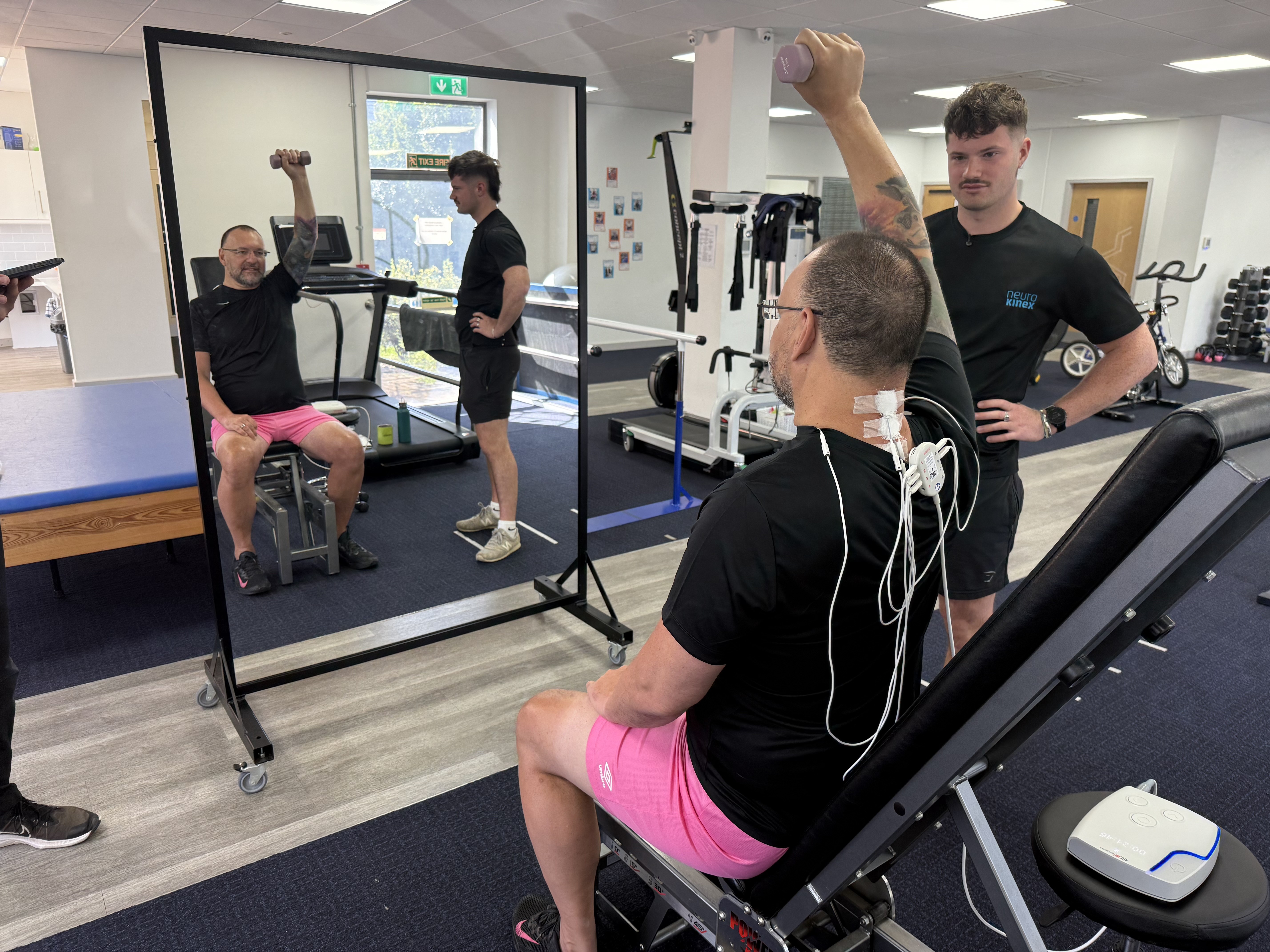
In 2016, Steven Dowd sustained a cervical spinal cord injury and was initially paralysed from the neck down. Ten years later, he is undertaking an eight-week ARC-EX and Activity-Based Rehabilitation (ABR) programme to explore whether further meaningful improvement is still possible, documenting the journey on social media.
Four weeks in, Steven spoke to Neuro Rehab’s Sarah Clarke about his inspiration behind the project, what it involves, and how he hopes it will encourage others with spinal cord injury to stay curious about their potential.
How did you acquire your injury?
On June 3, 2016, I was involved in a cycling accident that left me with an incomplete cervical spinal cord injury (C3/C4). I was initially paralysed from the neck down and underwent emergency surgery at St George’s Hospital in London as part of a clinical trial called ISCoPE. The research for this trial was funded by Wings for Life, a spinal cord research charity.
The injury changed every aspect of my life. Aside from experiencing a psychoemotional explosion, simple activities that most people never think about, like moving, eating, dressing or holding a cup, suddenly became enormous challenges. Like many people with spinal cord injury, my early focus wasn’t on recovery in the long term. It was simply on getting through the next hour, the next day and the next week.
What has your journey to recovery looked like so far?
I was incredibly fortunate to participate in the ISCoPE clinical trial, a surgical intervention which focused on monitoring and reducing intraspinal pressure caused by bruising of the spinal cord immediately after traumatic cervical spinal cord injury. Even during my four months in hospital, I committed myself to intensive rehabilitation and went offsite to an independent centre called Neurokinex for Activity-Based Rehab (ABR) sessions.
Over the past decade I’ve regained far more function than many people expected. Today, I can walk, run, row, ski and cycle again. For charity, I’ve completed a 100-mile bike ride on a turbo trainer, took part in the Wings for Life World Run several times, created a four-hour indoor rowing challenge and even became the first quadriplegic to virtually summit Everest on my stairs during lockdown.
Whilst I’m immensely proud of these achievements, such milestones don’t tell the whole story. There are still things I struggle with every day. My hands remain my biggest frustration. I still knock drinks over because my fingers don’t open when I expect them to. Typing, writing, dressing and countless everyday tasks continue to demand far more effort and mental energy than they should. I also live with full body spasms, altered sensation and constant neuropathic pain.
In many ways, I’ve reached the point where the biggest barriers are no longer dramatic; they’re the hundreds of small moments that quietly shape my everyday independence.
What inspired you to explore whether improvement is still possible ten years after incomplete cervical spinal cord injury? And why now?
This project began with a simple observation. People often talk about recovery as though it has an expiry date. The greatest improvements usually happen in the weeks and months after injury, and many people, including clinicians, assume that after a couple of years there is little more to gain. It’s even described as the “two-year window” by many people. Whilst the stats may support that phrase, I’ve always believed we each have our own story and our own potential, and I wanted to keep exploring my potential.
This June marked ten years since my injury, and I found myself asking a question: “If new rehabilitation technologies, like ARC-EX spinal stimulation therapy, and established, trusted approaches, like ABR, continue to evolve, what happens if someone who’s ten years post injury tries again?”
After some research, I found nothing out there to help me reliably answer the question. So that’s precisely why I took it upon myself to independently document it. For me, and for others like me.
This isn’t a clinical trial, and I’m not trying to prove that a particular therapy works. I’m simply exploring an honest question with optimistic enthusiasm and realistic hope, sharing whatever I observe along the way.
What does your eight-week programme involve, and which rehabilitation experts will you be working with?
I’m undertaking an intensive eight-week programme combining ARC-EX therapy, ONWARD Medical’s non-invasive spinal cord neuromodulation technology, with Neurokinex’s ABR. Both are delivered by specialist rehabilitation trainers at Neurokinex (Gatwick).
The programme consists of three two-hour sessions each week, combining one hour of ARC-EX stimulation with one hour of ABR.
What motivates you to keep pushing for progress after so many years?
For me, rehabilitation has never really ended. I still refer to myself as a ‘recovering quadriplegic’. I think I always will. It’s easy to look at the significant things I’ve gained and conclude that the story is finished, but every improvement, however small, has the potential to make everyday life easier.
If I could improve my hand function, or my bowels, or my balance by even a modest amount, the impact would extend far beyond the therapy room. It would affect how I work, how independently I live and how confidently I interact with the world. I’m also motivated by curiosity. Most documentaries already know how the story ends. This one doesn’t. I’m genuinely interested in discovering what might still be possible.
What barriers still limit progress for people living with spinal cord injury?
One of the biggest challenges is the widespread perception that recovery eventually stops. Many people lose access to specialist rehabilitation after the first year or two following injury. External funding often reduces, private funds may run out, services become sporadic or less intensive, and people naturally begin adapting their lives around their impairments.
Adaptation is incredibly important, but, at least for me, it shouldn’t necessarily mean abandoning the possibility of further improvement.
Another challenge is that spinal cord injury looks very different from one person to another. Even people with apparently very similar injuries can have very different outcomes, making it difficult to draw broad conclusions from any single experience.
What are your predictions for the outcomes of this programme?
I don’t have any. In fact, I’ve deliberately avoided making predictions. The purpose of this project isn’t to prove myself right - it’s to remain as objective as possible and document what actually happens, as it happens.
Perhaps nothing meaningful will change. Perhaps there will be small changes that matter enormously in daily life. Perhaps there will be improvements that are measurable but not immediately noticeable.
I just don’t know, and I think that uncertainty is one of the most interesting aspects of this project. As I write this however, I’m halfway through the programme and I am noticing changes, some of which seem to be persisting not just immediately after the stimulation but days after a session. I’m excited about that.
How do you hope your journey will inspire others living with spinal cord injury?
More than anything, I hope it gives people permission to challenge perceptions and stay curious about their potential.
I’m not trying to create unrealistic expectations or suggest that everyone will experience the same outcome. Every spinal cord injury is different and every response to neuro rehab is different. I do hope people see that actively asking questions is worthwhile, even years after injury.
If someone watches this project and decides to re-engage with rehabilitation, ask different questions or simply feel a renewed sense of possibility, then this project has served its purpose.
Do you think the outcomes of your journey will support future rehabilitation research and improve long-term rehabilitation pathways?
One person’s experience can never answer scientific questions but what it can do is raise interesting ones.
If documenting this journey encourages further discussion around long-term neuro rehab, highlights the importance of ongoing research or reminds clinicians and patients that meaningful questions still exist many years after injury, then I think that would be a really positive outcome.
Ultimately, I’m not trying to provide answers on behalf of the spinal cord injury community. I’m simply documenting one person’s attempt to find one.
What rehabilitation approaches remain effective for you ten years after injury?
I’m still discovering that. I feel like I’m wrapped in elastic bands all the time. Passive and active stretching, deep tissue massage and percussion guns all have their place in trying to relax very tight muscles.
I’m a big fan of indoor rowing as it’s full body, zero impact and combines both cardio and strength training. It’s also a very adaptable sport as I can isolate different body segments and still row. I’m excited to be back doing ABR because it encourages repetition, challenge and continual problem solving rather than simply maintaining what I already have.
Beyond any specific intervention, I’ve learned that recovery is rarely about finding a single breakthrough. It’s usually about consistently exposing the nervous system to meaningful, purposeful activity over long periods of time. New movements. New sports. New challenges.
Whether that still produces measurable improvements after ten years is exactly what this project hopes to explore.
Follow the journey
To follow Steven's journey on social media visit:
- Instagram: @mrstevendowd
- LinkedIn: linkedin.com/in/stevendowd