
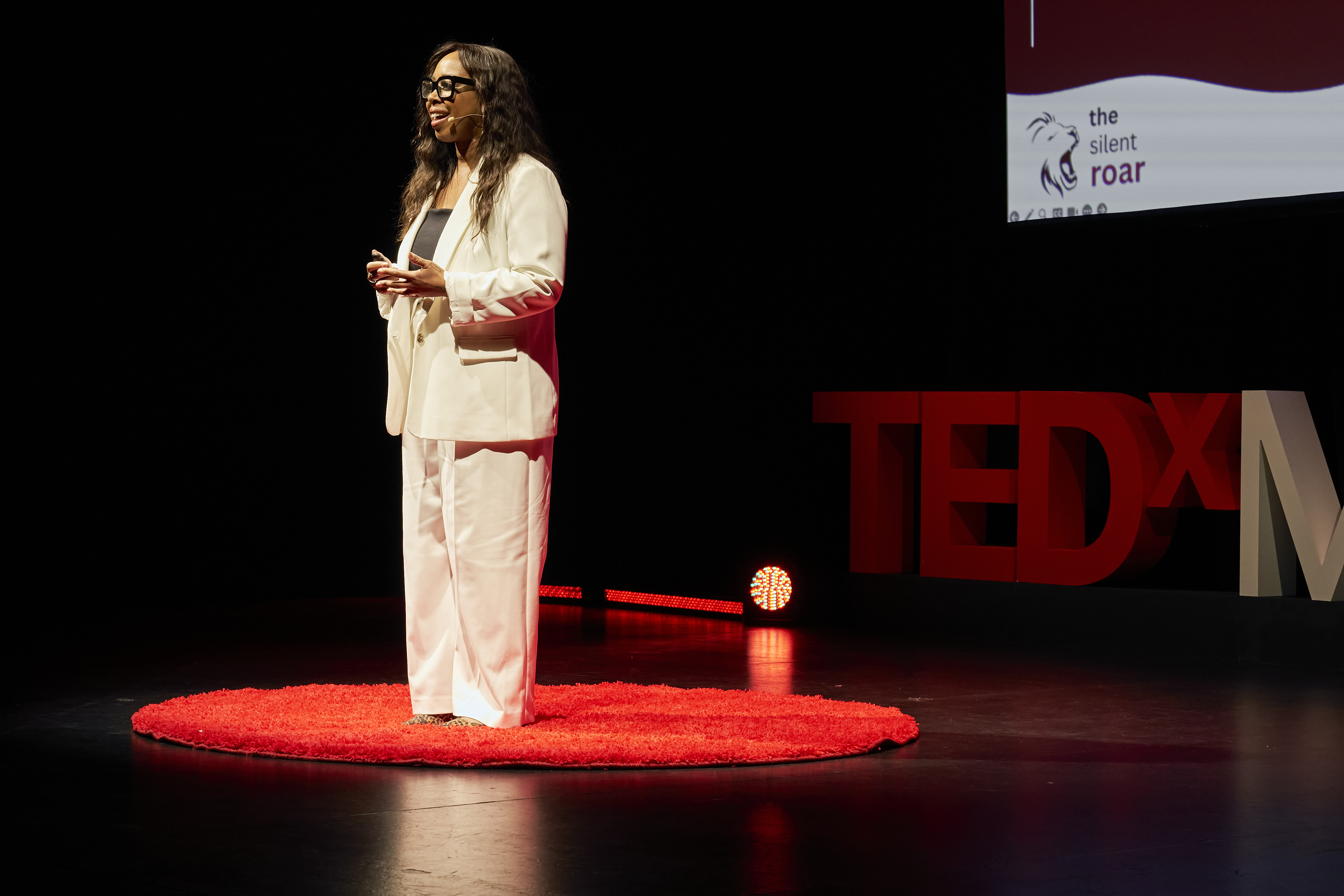
Pamela Aculey, a finalist in last year's Naidex competition, Elevate: The Disabled Founders Pitch, has fulfilled a lifelong ambition by delivering a TEDx Talk.
The award-winning author and founder of MIXD Reality, a company dedicated to making storytelling more inclusive and accessible, stood on the famous Red Dot to share the inspiring story of how her autistic son, Walter, taught her new ways to communicate that she never thought possible. She shared how her journey of understanding and connection has not only transformed the way they interact but has also strengthened their relationship.
In this article, she reflects on how the opportunity to deliver a TEDx Talk came about, the intense coaching that helped her get ready for one of the most significant moments of her life, and the powerful emotional response her speech received from audience members.
How it all began
A few years ago, I made a decision to invest in something I'd spent much of my life struggling with. My own voice.
I had a slight stutter growing up, and as an autistic woman, I've always been very conscious of the difference between knowing what I want to say and being able to communicate it in the way I imagine.
The irony wasn't lost on me. Here I was, building MIXD Reality, yet I still wanted to feel more confident telling my own story. So I hired my first ever speaker coach, the brilliant Cordell Jeffers.
During our very first session, Cordell asked me a question: "What's one of your big speaking goals?" Without hesitation, I said, "I'd love to do a TEDx talk one day."
I didn't want to do it simply to say I'd stood on that famous Red Dot. I wanted to take something deeply personal, something that had fundamentally changed the way I saw the world and turn it into an idea that might change how someone else saw theirs.
Over the following year, I saw several calls for TEDx speakers, but none of the themes really resonated. I knew I had a story to tell, but I wasn't going to force it into a conversation where it didn't belong. And then I saw it. I immediately thought of my son, Walter.
The story behind the talk
My son Walter is autistic. He was non-speaking until the age of eight, and our family found ourselves navigating a world we thought we understood, only to discover how little we really knew.
My husband Alex and I lost friendships. We lost trust. At times, we lost parts of ourselves. But we never lost hope.
I remember moments of sheer frustration, asking Walter, "WHAT DO YOU WANT?" I thought he wasn't telling me. I thought the problem was that he couldn't communicate what he needed.
But I was wrong. Walter had been communicating all along. Through his movements, his expressions, his behaviour and the countless little things I hadn't yet learned to recognise.
The problem wasn't his inability to communicate. It was my inability, at that moment, to recognise communication in a form I wasn't expecting.
And once I understood that I couldn't unsee it. It changed how I parented. It changed how I understood disability, difference and human connection and it changed the questions I asked and the assumptions I made.
It also helped shape the work we do today through MIXD Reality.
I founded MIXD Reality with a belief that every child deserves to see themselves represented in stories, and that accessibility should be considered from the very beginning, rather than treated as an afterthought.
We use Augmented Reality (AR), technology that allows digital animations, characters and interactive experiences to be layered onto the physical world through a smartphone or tablet.
Our children's book, Buster Finds His Beat, for example, can be enjoyed as a traditional picture book, but also offers an optional AR experience that allows children to explore characters, environments and elements of the story in different ways.
For us, AR isn't about using technology simply because we can. It's about creating more opportunities for children to connect with stories.
Some children engage through written language, others through visual experiences, movement or interaction. There isn't one correct way to experience a story, just as there isn't one correct way to communicate.
The goal isn't to make children adapt to the story. It's to create stories that can adapt to the child.
Walter taught me that difference doesn't mean deficit, and that understanding has influenced everything we create.
How often do we underestimate someone simply because they do things differently? How often do we judge someone's behaviour without asking what they might be trying to tell us? And how often do we mistake the absence of words for the absence of understanding?
These questions became the foundation of my TEDx talk, "My Son Was Communicating. I Just Didn't Know How to Listen."
Standing on the Red Dot
What people don't always realise about TEDx is just how much work happens before anyone sets foot on that famous red dot.
For three months, all of us speakers underwent an intensive programme of training and preparation to get us stage-ready. And when I say intensive, I mean intensive!
We were challenged to examine our ideas, refine our messages and think carefully about what we wanted our audiences to take away. Every word had to earn its place. Every story needed a purpose. Even the pauses mattered.
It was demanding, but it was also absolutely necessary because a TEDx talk isn't simply an opportunity to tell your story - it's an opportunity to communicate an idea worth sharing.
And there's a huge difference between telling people what happened to you and helping them understand why it matters to them. For me, that distinction was particularly important.
I wasn't simply sharing a personal experience; I was sharing something deeply connected to my son, my husband, our three boys - and the way society understands communication and disability.
I wanted to make sure I did that story justice without losing the vulnerability and humanity at its heart. The training taught me that powerful public speaking isn't about delivering a perfect performance. It's about creating a genuine connection with the people listening.
And sometimes that means being brave enough to leave the most vulnerable parts of your story in.
On Saturday 6 June 2026, I delivered my first TEDx talk at the Midlands Arts Centre in Birmingham, as part of TEDxMoseley's The Silent Roar.
And suddenly, there I was. Standing on that Red Dot, telling a room full of strangers about one of the most vulnerable periods of my life.
I was nervous, of course, but I was also incredibly proud. Because although I was the person standing on the stage, it wasn't just my story. It was Walter's story. It was my husband Alex's story. It was our family's story.
And, in many ways, it was the story of every person who has ever been misunderstood because the world wasn't looking closely enough.
The moment I'll never forget
After all the talks had finished, the speakers were invited back onto the stage to answer questions from the audience.
A woman stood up. She told me that her grandson was autistic and non-speaking. And then she said something I will carry with me for the rest of my life.
After listening to my talk, she had realised just how incredibly special the relationship she already had with her grandson was. She had begun to see their connection differently. To recognise that the love, understanding and communication between them had never depended on spoken words.
She explained that my talk had completely changed the way she thought about verbal communication. I can't adequately describe what that moment meant to me.
Because somewhere in that audience was a grandmother who had arrived with one understanding of her relationship with her grandson and was leaving with another.
Her grandson hadn't changed. Their relationship hadn't changed.
That was everything. That was the reason I wanted to give this talk. Not for the applause. Not for the photographs. Not even for the extraordinary privilege of becoming a TEDx speaker.
But for the possibility that someone might hear Walter's story and go home looking at another person with a little more understanding, curiosity and compassion.
The response to the talk has been incredibly moving, but that exchange with the grandmother will always stand out.
What the experience means to me now
One day, Walter will be able to watch this talk and understand just how profoundly he changed my life. He was the person who taught me that communication doesn't have to look familiar to be meaningful.
That understanding isn't always found in words. And that sometimes, the greatest barriers people face aren't created by their differences, but by the assumptions other people make about those differences.
I'm enormously grateful to Cordell for helping me find the confidence to tell this story, to the wonderful TEDxMoseley team for three months of extraordinary support, training and belief, and to my husband Alex, my soulmate, best friend and partner in everything we do.
I may have been the one standing on the stage, but it was Alex, Walter and I who wrote this story together. I set out wanting to become a better speaker.
What I gained was the opportunity to make someone feel seen. And if there's one thought I hope people take away from my talk, it's this:
"Walter had a voice long before he had words. He didn't need me to give him one. He needed me to recognise the one he'd always had."
Sometimes, the most powerful thing we can do for another human being is to question what we think we already know. To challenge our assumptions. To listen differently. To look again.
The full TEDx talk is available here: https://www.youtube.com/watch?v=nLo8o-OMuO0