
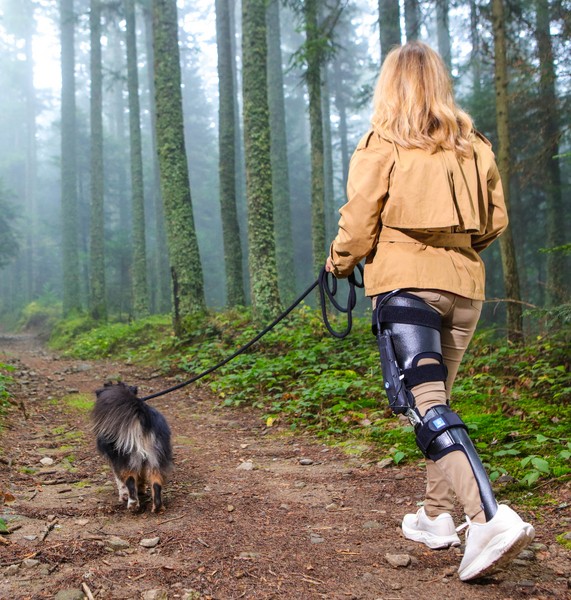
Thuasne has unveiled the results from a live trial of its smart‑powered orthosis, with patients left feeling “blown away” by the experience.
The manufacturer tested the efficiency of The Agilik, a lightweight solution developed in partnership with Bionic-Power, during one-hour assessments at Neuro Rehab last month.
The device is designed to help children and adults with lower limb weakness walk with a straighter, more controlled leg and improve gait stability.
Unlike other exoskeletons that intend to hold a patient up and walk for them, it functions as a mobility device by assisting or resisting knee extension and flexion throughout the gait cycle.
Thuasne Clinical Director Sean Adams explained: “It can assist people to stand up because it’s a powered joint unit, providing extension. So, standing up and sitting down is made significantly easier because it stabilises the knee, providing extension power to straighten the knee. The testing demonstrated that turning around is a lot safer and faster,” as seen in the timings.
Eighteen patients with varying conditions, including muscular dystrophy, spinal cord injury, traumatic brain injury, and functional chronic fatigue, took part in the live trial.
Live testing: What was involved?
Thuasne carried out three tests during each one-hour assessment. The first was ‘timed up and go’, in which patients started from a seated position, stood up, walked three metres, turned around, and returned to the seated position.
“This test was quite important because, in my experience, most patient falls occur when standing up, sitting down or turning,” Sean said.
Another test involved walking 10 metres in one direction from a standing start.
Finally, patients were asked to complete an 18-metre circuit around the perimeter of the Thuasne exhibition stand, before walking up and down a set of stairs, if they were able to do so.
All tests were completed with and without the smart-powered unit turned on.
Striking results
Across 12 analysed cases, the mean ‘timed up and go’ time improved from 38.64 seconds without power to 25.43 seconds with power. That equates to a reduction of 13 seconds and a 34% improvement.
The average time to complete the 10m walk improved from 36.29 to 24.47 seconds, a 32% improvement.
And for the eight patients who completed the 18m circuit, the average time improved from 48 to 37 seconds, a 21% improvement.
Stair climbing performance also improved, with achieved ascent increasing from six out of 12 patients without power to 11 out of 12 with power. Of those patients, seven out of 12 were able to walk with reciprocal gait, meaning they could bring one leg onto the first step, then bring the other leg onto the next step, as opposed to the same step.
Commenting on the results, Sean said: “Some patients couldn’t walk up the stairs at all without the power on, so that’s obviously a massive indication of Agilik’s performance because it enables people to move around spaces unaided, which is fantastic. That’s what the technology is aiming to do.”
He added: “Using the device, patients were in control, their balance was better, and their posture was improved.”
Fine-tuning for even greater performance
To put the study findings into context, the live trial was carried out in a busy exhibition environment in limited one-hour slots. By contrast, Thuasne’s trials usually take place privately and run for 90 minutes to two hours.
“At the show, we conducted very brief muscle power testing and relied on our clinical experience to estimate the level of power that each patient would need to aid their mobility, as opposed to fine-tuning it to meet their individual needs,” Sean explained.
“So, to be able to carry out the assessments so quickly and in a fairly frantic environment, and then to witness such remarkable improvements in people’s posture and gait was quite remarkable.”
The live testing conditions were also suboptimal because many participants required a foot and ankle orthotic (AFO), designed to control or keep the foot positioned at a 90-degree angle.
“A lot of patients were walking with slight plantar flexion and having to rely on compensatory gait patterns, but they still managed to record good scores.”
Sean believes that if the Thuasne team had the time and ability to address these issues, the results would have been even stronger.
“I’ve personally trialled the test drive, and I’ve also tested a fabricated final device that was personalised to my anatomy. The difference was quite striking,” he said.
“We would estimate an improvement of 40% to 50% on what we’ve seen from the test drive once the final device is ready. It’s all very exciting.”
Patient feedback
Of the 12 patients who trialled Agilik, 100% reported an improved walking experience when the power was turned on.
Several participants described the technology as “amazing” and said they were “wowed” by the experience, with most expressing that they hope it will be made available on the NHS.
Sean said, “Hearing the patient feedback at Neuro Rehab, I think they were pretty blown away by Agilik.”